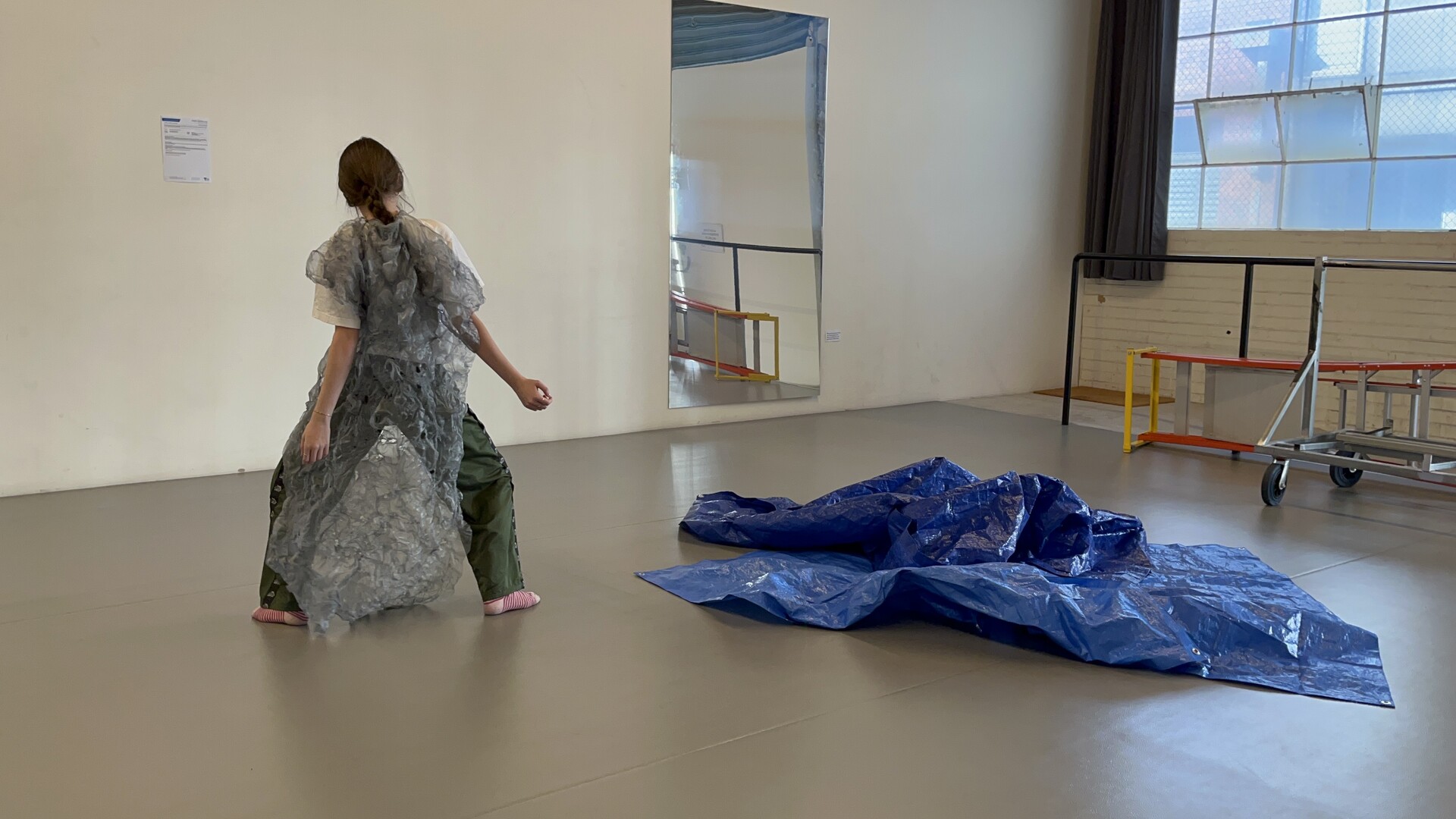
‘Until the Monster Returns’ is a work in progress that researches the physical and psychological responses to large environmental disruption, reflecting my lived experience of the 2011 Tōhoku earthquake and tsunami in Japan. Using reimagined debris, this work simulates autonomy and instincts when our bodies absorb and adapt to environmental displacement in its aftermath.
The movement language in this work has a tangible presence, experimenting with the materiality of domestic objects and their journey to isolation in debris, through the lens of Japanese architecture and personified memory.
Imagination redirects a community’s recovery journey into possibilities, by recycling materials towards effective infrastructure rebuilding and environmental solutions, rather than repairing them back to their previous shape. Taking example from the 2011 disaster, damaged domestic objects were repurposed by mindful debris disposal from care, attentiveness and integrity. When abandoned with mountains of debris, the landscape draws attention to each object, which were once designed with purpose and holds a memory of functionality with human interaction. Vice versa, the human experience of its tactile experience keeps an archive in their body. When hand-picking through debris, there is a breathtaking conversation between every human presence and object through this physical language of nostalgia.
Despite the brutal relationship between nature’s raw power and our fate in survival, how do we accept the transience of life in conflict with emotional attachment to the past?
Personally as a Japanese, this is something that haunts our people all the time. Constant earthquake warnings, high magnitude earthquakes putting life in danger, aftershocks, tsunamis, and dealing with radioactive debris under international pressure. Moving forward while anticipating these disasters and accidents in near future subconsciously builds underlying terror. No one to blame, they accept mortality, then realise that we are temporary beings residing on Earth, as humanity can never be in control of nature. It’s also a matter of time until Mount Fuji erupts and ashfall causes major damage to infrastructure as it is an active volcano.
Since Postwar Japan, the recurring fear of disaster is often symbolised in films as an immortal monster, Gdzlla, frequently returning to destroy Japan’s landscape. I was inspired by its distinctive perspective unlike most Western superhero films. In the studio we used imagined keloid scars on skin (to recreate Gdzlla’s skin texture and radioactive spikes) and embodied how he would reorganise his body after a battle and return to the sea to heal. In developing my work, I want to integrate the embodiment of Japanese coping mechanism practice into a movement style that builds resilience against external chaos… like him.
Japanese subculture also plays an important role in distraction as a coping mechanism from the high-pressure society. In the studio, we did a little bit of casual dancing inspired by 2010’s J-pop idol music and choreography. The upbeat synth sound that created an escape from the harsh reality 15 years ago, had a somewhat similar effect to the tone of this work (I think).
Australian landscape experiences recurring natural disaster and near misses, but we often withdraw from unprepared crisis and deflect underlying fear. I wonder how presenting this work to the Australian audience translates to them, and if viewers would find it relevant enough to engage with the heavy background narrative in an international context.
Because I spent a lot of time building the world and collecting embodied movement into a physical language, I have to admit that sometimes I get lost in what I am trying to convey through this work. But when these movement ideas assemble into a sequence, I hope that viewers can associate the human relationships under pressure and the human-object connection to other lived experiences of disaster or even personal breakthroughs.
About Rena
Rena Sangawa (she/her) is a dance artist based in Melbourne/Naarm and Sydney/Gadigal, holding a Bachelor of Fine Arts (Dance) from the Victorian College of the Arts. Led by existentialism and Japanese philosophy integrating Shinto beliefs and diverse intellectual tradition, she finds passion in performing and creating works that question realness in digitalised lived experience.
Rena has a training background in classical ballet and contemporary, in 2025 she trained with ImPacT at ImPulsTanz Vienna International Dance Festival mentored by Kerstin Kussmaul (with Ultima Vez, Alleyne Dance, Alexander Vantournhout) and b12 Berlin Workshop Festival (with Vasko Nasonov, Dual Rivet).
In the last 3 years she has performed with the UoM Master of Music, RISING, Science Gallery Melbourne, and more. Through the VCA, Rena collaborated with Melissa Toogood (supported by Merce Cunningham Trust), Gregory Lorenzutti, Chimene Steele-Prior and Luke George. Rena is proud to have directed and choreographed ‘//command_shift^ break’ which premiered in Union Theatre. She also performed her site-specific work ‘transmitting magenta’ in Melbourne Fringe Festival commissioned by the University of Melbourne Student Union.
Following secondments with Legs On The Wall, she was a Leg Up member for mentorship in 2025 which supported the initial development of her new work ‘Reclaiming Home’.